by Jacob Zhicheng Zhang // Oct. 16, 2026
This article is part of our feature topic Performativity.
Performativity indicates action—and not necessarily the kind involving physical movement. In J.L. Austin’s theory, a performative utterance does not merely describe or refer. Under the right conditions, the utterance can constitute an action in itself. “The East,” I would suggest, acquires something of this performative force in ‘Projections Onto the East,’ which is held jointly by Schinkel Pavillon and Neuer Berliner Kunstverein (n.b.k.). Fabian Bechtle and Leon Kahane, the curators of this exhibition and publication project, do not explicitly draw any correlation between “the East” and performativity theory. Yet, once we view the works included in the show and consider the array of realities that the repeated invocation of the term has brought forth, it is hard not to think of “the East” as a term with performative power. The exhibition is most compelling when it repeatedly examines “the East” till it summons the term’s real consequences. There is a crucial caveat: “projections” also remain in plain sight—the critical curatorial framework itself does not escape the mechanism.
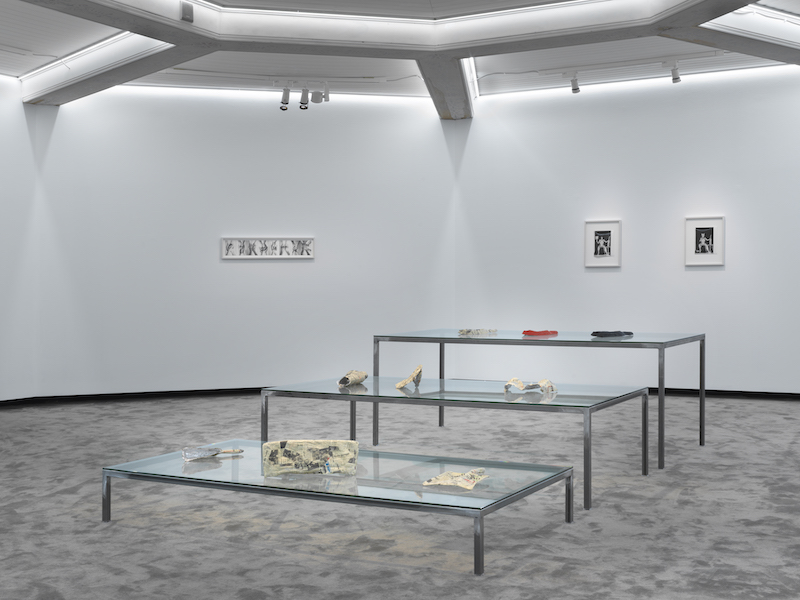
Gabriele Stötzer: 6/8 objects from the series ‘Everyday Objects,’ 1991; ‘Gabi with Everyday Objects'(photographed by Karin Rocholl), 1992; ‘Hands Intertwined,’ 1982, exhibition view ‘Projections onto the East’ at Schinkel Pavillon, 2026 // Courtesy the artist, LOOCK Galerie, Berlin, © Photo: n.b.k. / Jens Ziehe
Gabriele Stötzer’s Stasi-inspired works open the exhibition at Schinkel Pavillon, which used to serve as a reception hall for state functions during the German Democratic Republic (GDR). Their inclusion of bodily forms gestures toward the artist’s wayward performing body in the GDR, and they would be familiar to those who have visited her recent solo presentations at LOOCK Galerie and Gropius Bau. Though the objects and photographs are coolly set up on a tiered pedestal and discretely hung on octagonal walls, the display speaks of tension, thanks to the headstrong message conveyed by the naked body and its papier-mâché traces made of newspapers. Within the former GDR reception hall, the artist’s suffering under and resistance to the nation’s political detention cannot be clearer. Meanwhile, the impression of the GDR as the paradigmatic “East” of today’s Germany is invoked again by this display, implicating the exhibition. Its presentation of Stötzer indicates that it is not immune from this projecting fascination with Ostdeutschsein.
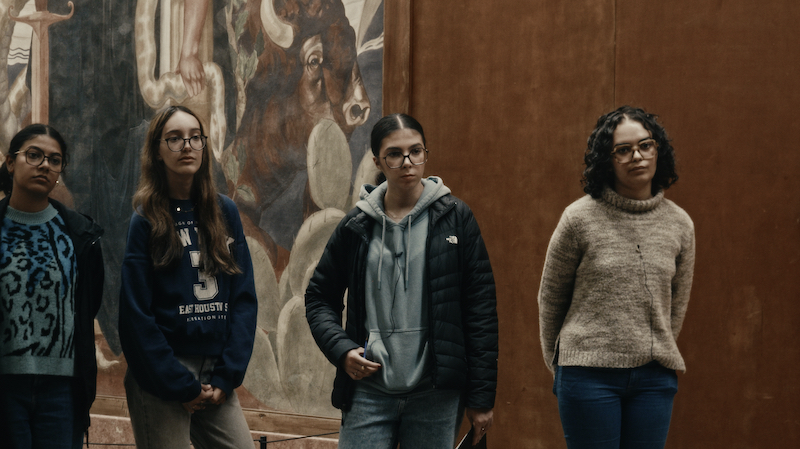
Maya Schweizer: ‘Suis son regard et observe (Follow Their Gaze and Observe),’ 2026, ‘Projections Onto the East’ at Schinkel Pavillon, 2026 // Courtesy of the artist, © photo n.b.k. / Jens Ziehe
As yet another wry poke at the GDR, the opening scene fails to really question “the East”; however, perhaps inadvertently, it allows us to grasp “the relationship between attribution and reality” that Bechtle and Kahane assign to “the East.” The rest of the exhibition project across Schinkel and n.b.k. swings the pendulum between attribution and reality, between unstable projections and weighty consequences. In her video work ‘Suis son regard et observe’ (2026), Maya Schweizer touches on the borders of realism by having inquisitive students of philosophy critically engage with a fresco painted in 1931 by Pierre-Henri Ducos de la Haille for the Paris Colonial Exhibition. Its narrative realism, reminiscent of populist Mexican muralism, takes on heavily imperialist connotations—the video gradually reveals this turn of events through its unfolding dialogues. It then pushes one to ponder how a metropolitan mural might fit into a woefully real intercontinental colonial project.
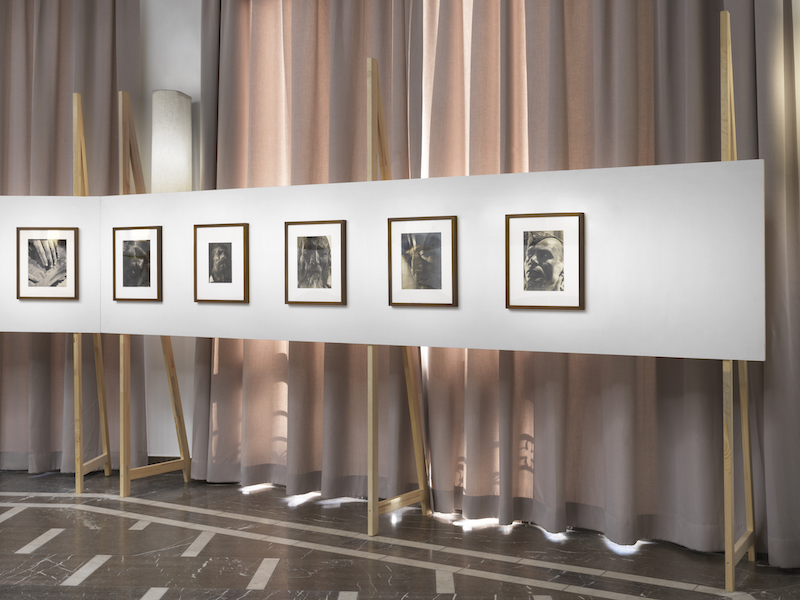
Helmar Lerski: from left to right: ‘Chawer in Kibbutz with Car Tire’ from the series ‘Human Hands,’ circa 1930–44, exhibition print // Courtesy Estate of Helmar Lerski, Museum Folkwang, Essen; ‘Untitled (Jew)’; ‘Untitled (Jew from Turkestan)’; ‘Persian Jew in Palestine,’ all from the series ‘Arabs and Jews,’ circa 1931–35; ‘Private M., Poland,’ from the series ‘Jewish Soldiers,’ circa 1942–43 // Courtesy Estate of Helmar Lerski, Kicken Berlin, exhibition view ‘Projections onto the East,’ Schinkel Pavillon, 2026 // © photo n.b.k. / Jens Ziehe
Upstairs, photographs by Helmar Lerski plainly circle the hall at eye level. The occupations suggested by the dramatically lit closeups of working hands—the subject of the series ‘Menschliche Hände’ (1930–44)—recall the typological photo survey of German society by Lerski’s contemporary, August Sander. Nearby, like Sander’s democratizing work, Lerski’s ‘Araber und Juden’ (ca. 1931–35) and ‘Jüdische Soldaten’ (ca. 1942–43) appear to insist on a shared visual and social field. Yet, the titles reinstate precisely the difference that the shared field hopes to level.
Moving to n.b.k., we see a continuation of this homing in on Jewish perspectives—a topic Bechtle and Kahane have long explored since their creation of Forum for Democratic Culture and Contemporary Art in 2018. The exhibition does hint at an internal diversity of voices, and this diversity does not lose sight of the element of projection. Shlomo Pozner’s ‘Hershel Tours’ (2026) is a work by a self-identified Jewish artist interested in Hasidism, a Jewish spiritual movement since the 18th century, and the Hasidic pilgrimage to graves of tzaddikim across Eastern Europe. In the mock advertising billboard that functions as a backdrop to the installation, the language of tour companies—written in a condensed, rounded font commonly found in commercial advertising—conjures both a sanctified longing for religious community and an expectation of packaged tourist comfort. Projection has found here a particularly literal home.
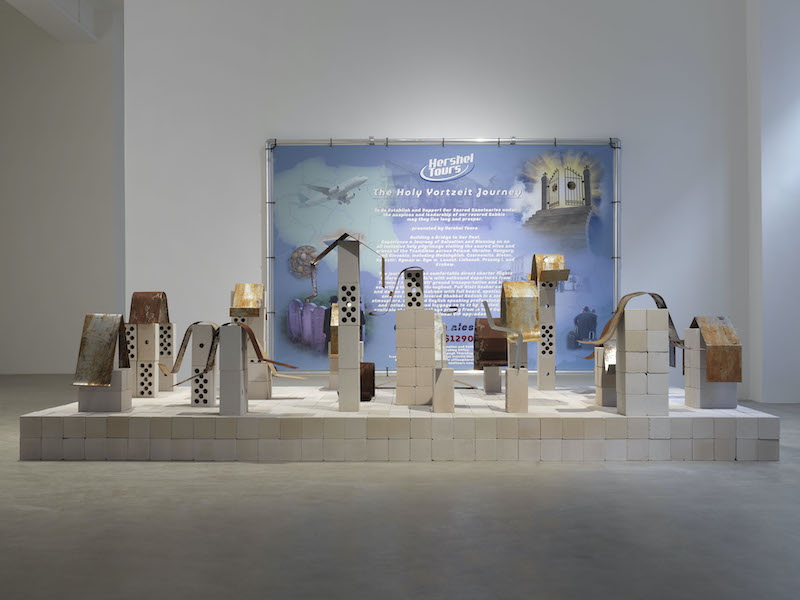
Shlomo Pozner: ‘Hershel Tours,’ 2026, exhibition view ‘Projections Onto the East’ at Neuer Berliner Kunstverein (n.b.k.), 2026 // © Photo n.b.k. / Jens Ziehe
Maksym Khodak’s ‘Breadbasket for Europe’ (2026) brings the theme to a new height, as it presents a well-disguised, para-fictitious video that banks on an existing myth. In a black box equipped with a 16-mm film projector, whose projection can be felt through the heat it exudes, a grainy black-and-white film plays, accompanied by a nasal, newsreel-style German voiceover speaking in propagandistic zeal. According to the translation of the voiceover detailed on a wall label, the Ukrainian “black soil” is coveted for its under-utilized fertility, making scientific intervention from the Third Reich appear warranted. Occasionally, the video features inconsistent depths of field as well as handwriting that appears too perfect, betraying a faint sense that something is amiss. Only the exhibition pamphlet confirms its fictiveness, stating that Khodak created the video using multiple AI tools. The German theft of the “black soil” is also revealed to be a Soviet myth popular in Ukraine. Referring to Ukraine but not necessarily its historical realities, “the East” here is an imaginary that can finally implode when its terms are dramatized.
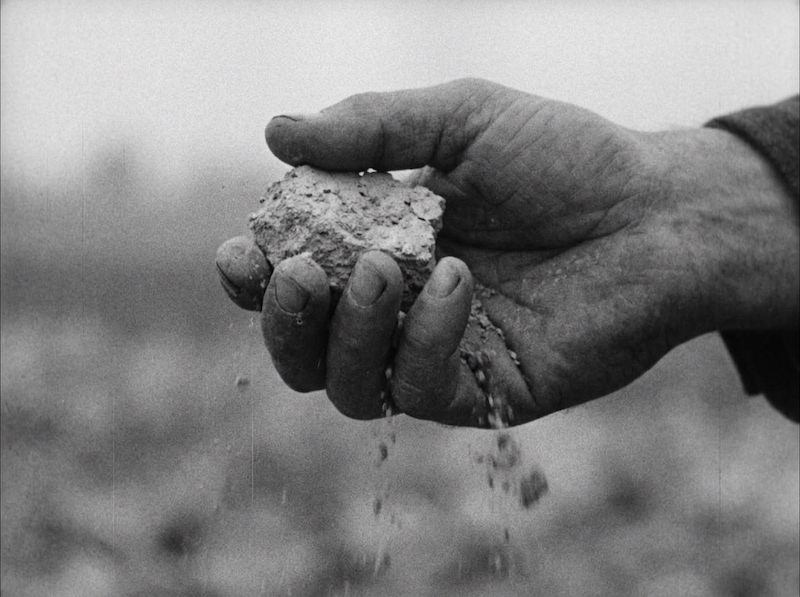
Maksym Khodak: ‘Breadbasket of Europe,’ 2026, 16 mm film, black and white, sound // © Maksym Khodak
That imagination meets its harshest critic nearby in Pavel Brăila’s ‘Vera Means Belief’ (2026). Despite being a Ukrainian refugee, Vera Derevianko has been living on the Ukrainian-Moldovan border in a refugee camp for two years, refusing to move to other parts of Europe like many of her compatriots did. Her Soviet experience and beliefs come most clearly in her painful telephone exchange with her daughter, when she sits dejected inside a tent and listens to the disappointment on the other side of the phone. Brăila’s realist but sympathetic lens portrays Vera as a victim of Soviet legacies and the Russo-Ukrainian war, weighing in on Ukrainians’ divergent visions after decades of Soviet and post-Soviet memory-making, as well as the sudden disillusionment of war.
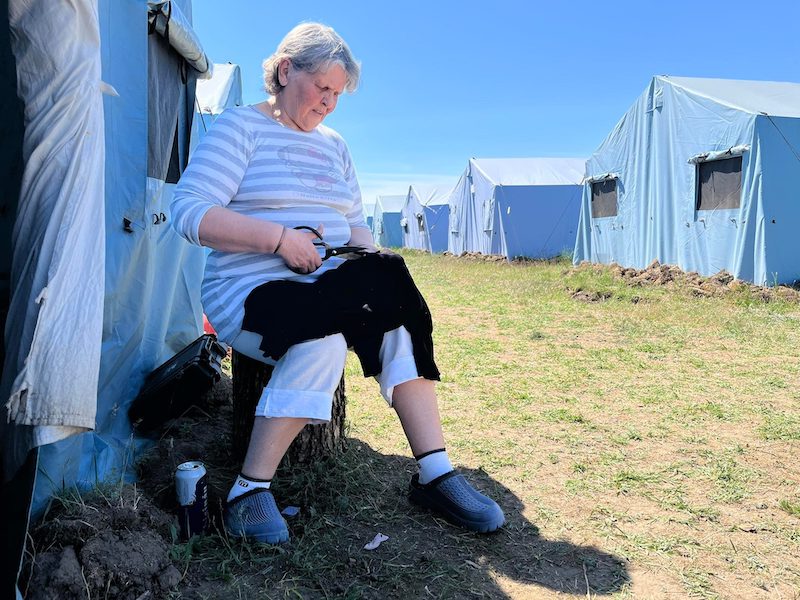
Pavel Braila: ‘Vera means believe,’ 2026, screenshot from video // © Pavel Braila
This video-heavy exhibition also shows other real victims, such as the speechless and turned-away Vietnamese contract workers in Hito Steyerl’s ‘Land des Lächelns’ (1990). The festive opening of a former border crossing between West Berlin and Brandenburg appears to exclude those workers, making one wonder if the collapse of one East necessitates the setup of another. Or, to put it differently, as we manage to examine one East, noting its entanglement between unstable attribution and performed reality, maybe another slips from view. Palestine under the British Mandate enters the exhibition obliquely through Lerski, whose photographs emerged within Zionist efforts to construct a new Jewish society in 1930s Palestine, even though works like ‘Araber und Juden’ might be seen as leveling the visual field. Beyond that, contemporary Palestinian experience amid the war in Gaza, unlike contemporary Ukrainian experience, remains conspicuously outside the scope.
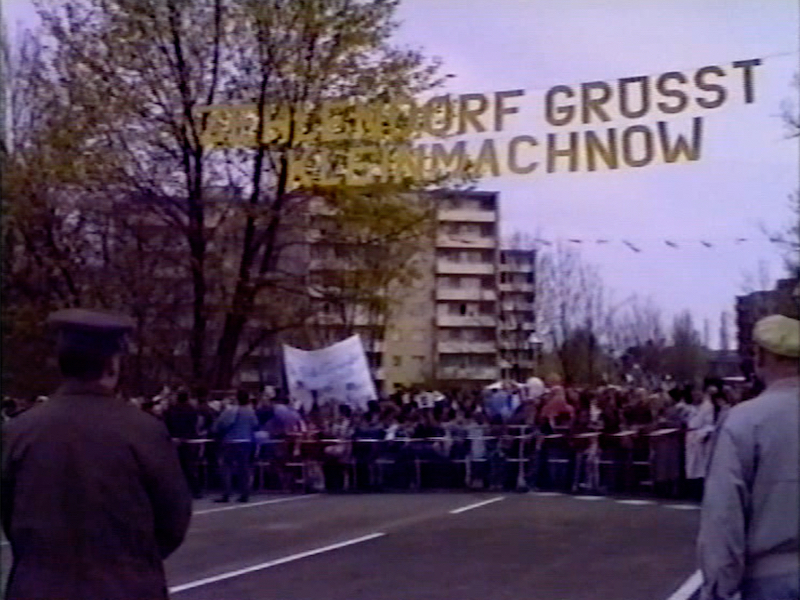
Hito Steyerl: ‘Land des Lächelns,’ 1990, SD video, 2:24 min // Courtesy the artist, Andrew Kreps Gallery, New York, and Esther Schipper, Berlin/Paris/Seoul
The exhibition claims to grant no art exemption from scrutiny. By giving “the East” a space to reproduce itself and allowing “projections” to become highly visible, the show exposes processes of romanticization both historical and contemporary. But when its own field of vision narrows, the show misses the opportunity to address its own limitations—how it, too, is subject to the mechanism of producing performative utterances and fanciful projections. Perhaps, in keeping with this spirit, the audience will have to remain on the lookout for “the East,” knowing that it will exist as long as “we” require it as a foil.
Exhibition Info
Schinkel Pavillon
Group Show: ‘Projections Onto the East’
Exhibition: Sept. 10–Dec. 20, 2026
schinkelpavillon.de
Oberwallstraße 32, 10117 Berlin, click here for map
n.b.k.
Group Show: ‘Projections Onto the East’
Exhibition: Sept. 10–Nov. 8, 2026
nbk.org
Chausseestraße 128-129, 10115 Berlin, click here for map