by Steph Kretowicz // Nov. 27, 2026
“That’s the nicest thing anyone has ever said to me,” says sophie serber, in reply to the suggestion that her work is confounding in its ability to be both coherent and elusive at once, making complete sense before dissolving into ambiguity. The Amsterdam-based artist is preparing for her solo exhibition, allegedly her last—a rumination on the self-consuming nature of pornography, and on where bodies, and consent, begin and end. Opened at GDL525 during Amsterdam Art Week, ‘This Quiet Place is Fantastic’ explores how language’s drive to contain is both a self-perpetuating and self-annihilating mechanism that makes a thing visible only by fragmenting it, one hashtag at a time, until there’s nothing left to label.
The last time I interviewed serber was in 2020. Anxious and under-slept during the COVID-19 pandemic in London, serber kept a color-coded document in front of her in an attempt to order her thoughts across oceans. We were talking about ‘Bracket Sentiment And The Technicolor Yawn,’ the exhibition I curated at Vienna’s Shore Gallery, where sculpture and painting, sound and smell, combined in a sickly sweet and slightly nauseating immersion into notions of sensitivity, immunity and reliance. “I was so prepared for the last interview.”
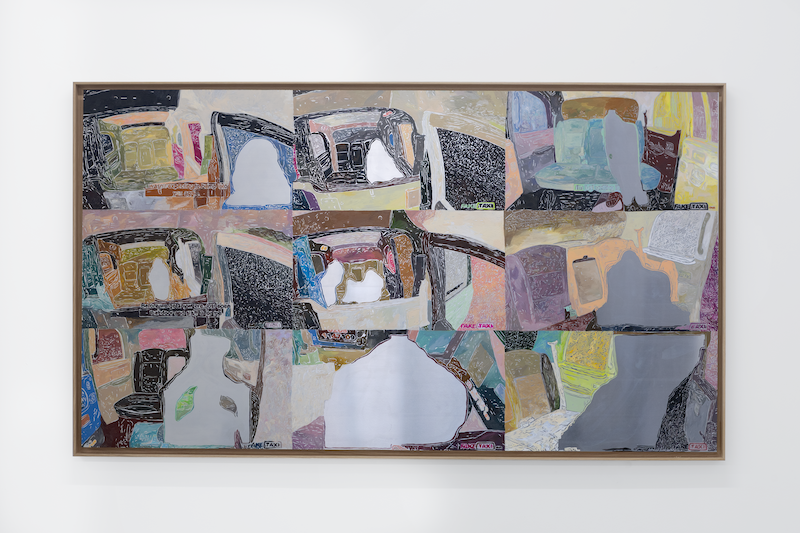
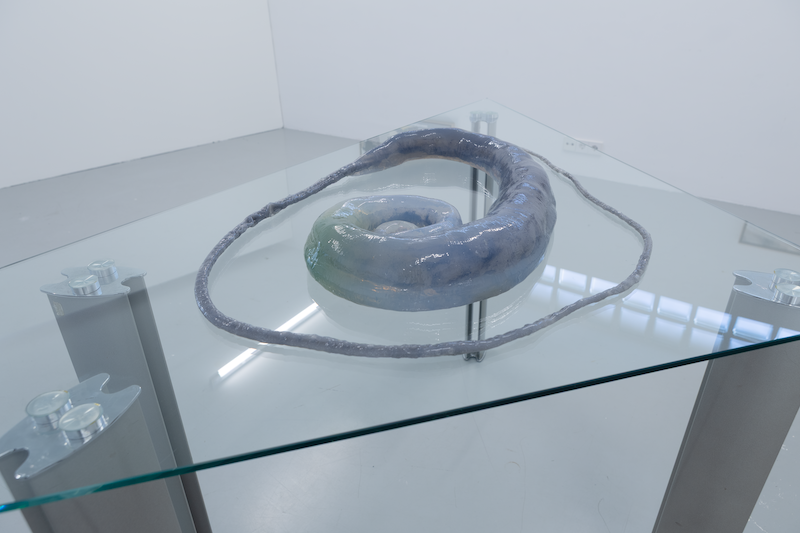
That show featured colored-in Digimon drawings framed by cereal with audio of serber breathlessly quoting passages butchered by Dragon Dictation’s transcription software, while pumping away on a treadmill. An eleven-foot, to-scale tapeworm called ‘Autophagy ii’ lay motionless on the gallery floor. Six years, a couple of moves and a number of exhibitions later, serber returns to the parasite as both object and subject for ‘This Quiet Place is Fantastic,’ alongside aluminum paintings that begin with her own porn scenes, run through a mask algorithm that blackens out any bodies it detects. This time the accompanying silicon sculpture is a worm within a worm, presented on a table and titled ‘Master Jeff, cccc,’ a reference to an obscure BDSM consent framework in which every intrusion is agreed to in advance. Where the 2020 tapeworm was an annihilating self-portrait in the form of a well-known parasite, 2026’s whipworm depicts an unknown other, one that invades, but by invitation.
“I was thinking about interdependence, the parasite as useful and this idea that you can only be fully seen or known in death,” serber explains, “which comes back to the hashtags and porn needing to reproduce more of itself in order to be itself.” The tags used to categorize porn make sexual content legible and classifiable, turning desires and practices into searchable categories, and each new category demands another until the cycle, as she puts it, is “killing itself.”
sophie serber: ‘This Quiet Place is Fantastic,’ 2026, installation view at GDL525 // Courtesy of the artist and GDL525
Steph Kretowicz: So when we were working in 2020, the porn aspect wasn’t very present in that work. What changed?
sophie serber: I was always very hesitant about making work with that because it’s so heavy or loud. It’s too noisy. It felt like it would be sexual. I was still very in it, honestly. I still take scenes sometimes but, at that time, I’d been in LA for six months, a year. I’d been working and I don’t think I was ready to make work about it yet, or with that content.
SK: When you say it was too noisy or too sexual, your work has this focus on non-meaning and meaninglessness, and then a sort of amorality. Was it still something that elicited some level of shame at that point. Was that why you didn’t want it to be fully public?
ss: Not shame, just safety. I don’t like being messaged by people online. It’s really violent getting harassed, that’s not fun. I wouldn’t really say it’s so much about shame, it’s more just not having trust in humanity, which I still don’t have. I think I have always been slightly naive about people.
SK: So you didn’t want to join the two worlds, right? Hence the pseudonym?
ss: I can’t imagine not having a pseudonym. Just because the internet is really a wild world. I never watched porn before I was in it and I’m not someone who thinks of these things as hot. I think about performing in scenes, or pornography as a way to access something that language can’t get; that it’s pre-cognitive. It’s a space where you can get out of yourself. I really liked that part of it.
sophie serber: ‘This Quiet Place is Fantastic,’ 2026, installation view at GDL525 // Courtesy of the artist and GDL525
SK: When you said it’s “too noisy” for art, I wondered if you meant too entertaining. Too easy?
ss: Yeah, it’s too easy. It’s how I think about SM too; thinking about these technologies of BDSM and about that in my work now, because that also feels like something that is easily aestheticized or reduced. With porn, the shock value of the body, it’s not actually shocking anymore because you’ve seen so much of it. It’s just kind of boring. It becomes nothing.
SK: Like people who consume too much porn and then get more extreme about what they’re into.
ss: Exactly. That’s how hashtags are created. In order for porn to be itself, you keep on having to make more and more because it’s killing itself.
SK: For ‘Bracket Sentiment And The Technicolor Yawn,’ you made a tapeworm self-portrait, and now there’s a new worm, ‘Master Jeff.’ What kind is it, and why is it him and not you?
ss: It’s a whipworm. People are taking them now. It’s the hygiene hypothesis, so some people are taking them for MS and other problems. I’m thinking about the same things—visibility and removal and interdependence, and relational parasitism—but this time with ‘Master Jeff.’ I’m also thinking about the technologies of SM. As something that seems bad for you on the outside, but it could also be good for you.
sophie serber: ‘This Quiet Place is Fantastic,’ 2026, installation view at GDL525 // Courtesy of the artist and GDL525
SK: What’s the difference between the ‘Master Jeff, cccc’ whipworm and the ‘Autophagy ii’ tapeworm?
ss: A tapeworm’s a parasite that’s very perceivable. People know what it is. The whipworm is made with the same materials, but this one is on a table. The 4Cs is a kind of consent framework. People know about RACK, which is “risk-aware, consensual kink,” or SSC, which is “safe, sane, consensual,” but everyone has a different definition for the 4Cs. There are three or four different ones that people use. The main one is “communication, consent, care and caution.”
I’ve been told about, or experienced it with total power exchange (TPE), or a 24/7 dynamic that involves consensual non-consent (CNC) because it doesn’t talk about sanity in the same way. It prioritizes communication and care more so than the kind of separation. I use that in the whipworm title because it’s thinking about this thing that invades you, but also people actively take it for a specific use or relationship.
SK: Did you successfully have all the videos you downloaded removed from the internet?
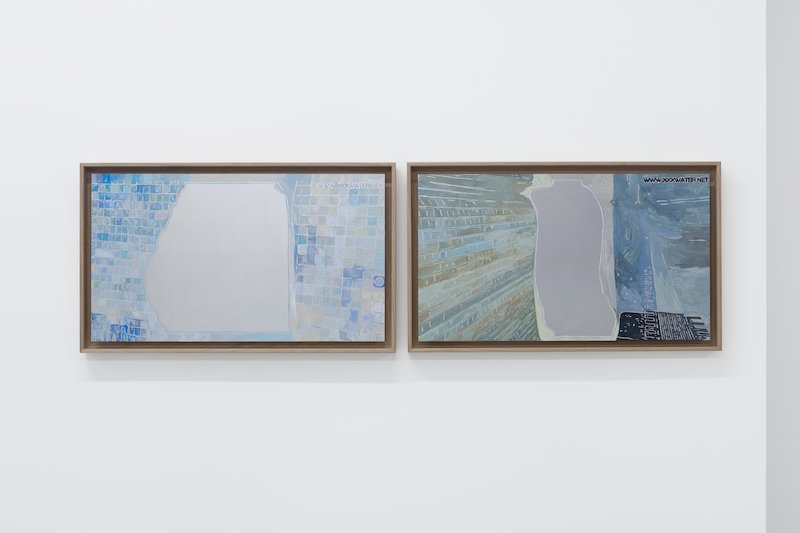
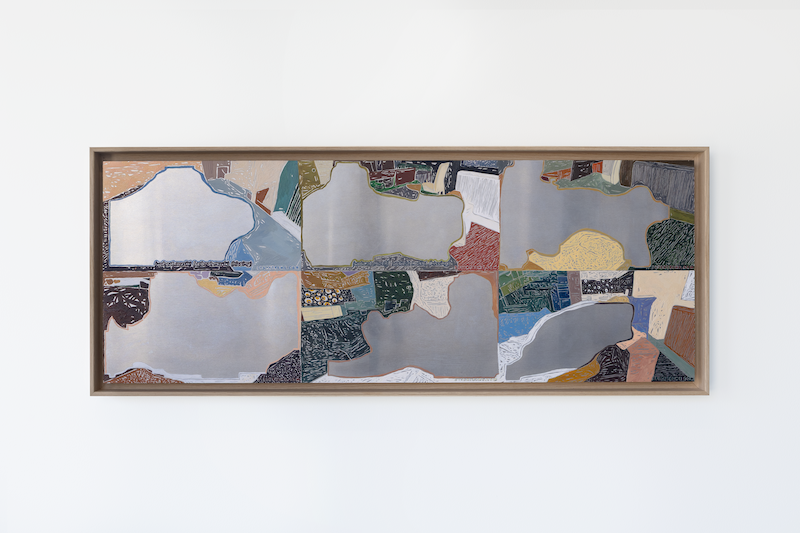
ss: No, not removed from the internet. I downloaded them and masked them, which looks like a block shape that moves and conceals bodies. I was interested in how it decided what a body was. It wasn’t so much about that removal, but more so about this threshold of understanding that this model had for what a human body was, and how close you can get. Nicholas Lister and Claes Storm put the films through that and, from there, the paintings were made from stills from that film. I’d take a still from the film and then put it through an app that turns them into coloring books.
sophie serber: ‘This Quiet Place is Fantastic,’ 2026, installation view at GDL525 // Courtesy of the artist and GDL525
SK: Why did you get the model to remove the bodies from the scenes, and why are you interested in the fact that the algorithm doesn’t necessarily recognize it?
ss: I’m interested in the threshold of when it does and when it doesn’t. Once the camera gets too close to the body, it doesn’t think it’s a body anymore. And then sometimes it’ll think furniture is a body. It didn’t cover up when my cervix was exposed, and it was very upsetting for someone. I was trying to make it not sexual. Thinking about the different spaces, and the different shots and the different cuts, and the movement. This other object, not so much as concealing but making it into something else, expanding.
SK: Someone was offended?
ss: I was invited to show my film ‘Success Breeds Success, or You Need to Be A Friend To Get a Friend’ (2024) to students, and a media theory student complained to the newspaper about seeing my cervix. We gave a warning, and there were also balls… It was just a shock value thing, which sucked because the article said something like “ex-pornstar,” it was stupid. I got so bummed that I didn’t show the film again. I was going to show it at festivals and do the whole thing but I didn’t do anything after that.
It really freaked me out because this writer linked my Instagram from this story. I started getting DMs from people on my art account and then people started searching my real name on all the tube sites to try and find my pseudonym. It just got really scary.
SK: Where does the title ‘This Quiet Place is Fantastic’ come from?
ss: It’s actually something I said in a scene that was made into a painting. There’s a lot of text in the paintings, because the captions are included, especially in the VR ones.
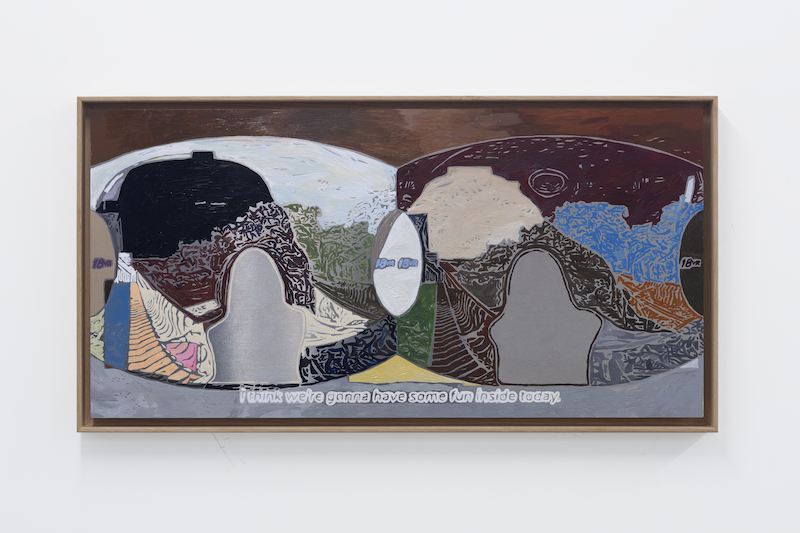
sophie serber: ‘This Quiet Place is Fantastic,’ 2026, installation view at GDL525 // Courtesy of the artist and GDL525
SK: You call this black shape in the film a “mask.”
ss: I’m thinking about the mask as something that conceals, but it also reveals something. It’s an addition but it’s also a subtraction. There’s death but there’s also some sort of, not exactly birth, but it’s a transcendence, it’s a void. There’s something else that can come out of that.
SK: Is a void nothing, or is it a thing?
ss: Exactly. It can be something. That’s why I need coloring books. That’s why I use them because I don’t know what else to do. I’ve always used them in my work. It’s a format and a structure, almost a condition, like gravity. And then with that, I worked around it and through it. Coloring books have often been this thing to break and use for myself. They’re also flattening. Quiet.
SK: So there are lines being drawn that you work around. Do you think that those lines are necessary, even if you come up against them, because otherwise you would be fully untethered?
ss: Yes.
Exhibition Info
GDL525
sophie serber: ‘This Quiet Place is Fantastic’
Exhibition: Nov. 19-Dec. 13, 2026
gdl525.com
Gouden Leeuw 525, 1103 KM Amsterdam, Netherlands, click here for map